Solar or a bigger battery? The honest camping calculation
Share this article
AI-assisted English translation of the German guide. Illustrative images are AI-generated, not product photos. Numerical claims from the original are contextualised, and safety advice has been clarified. We have not tested this equipment ourselves.
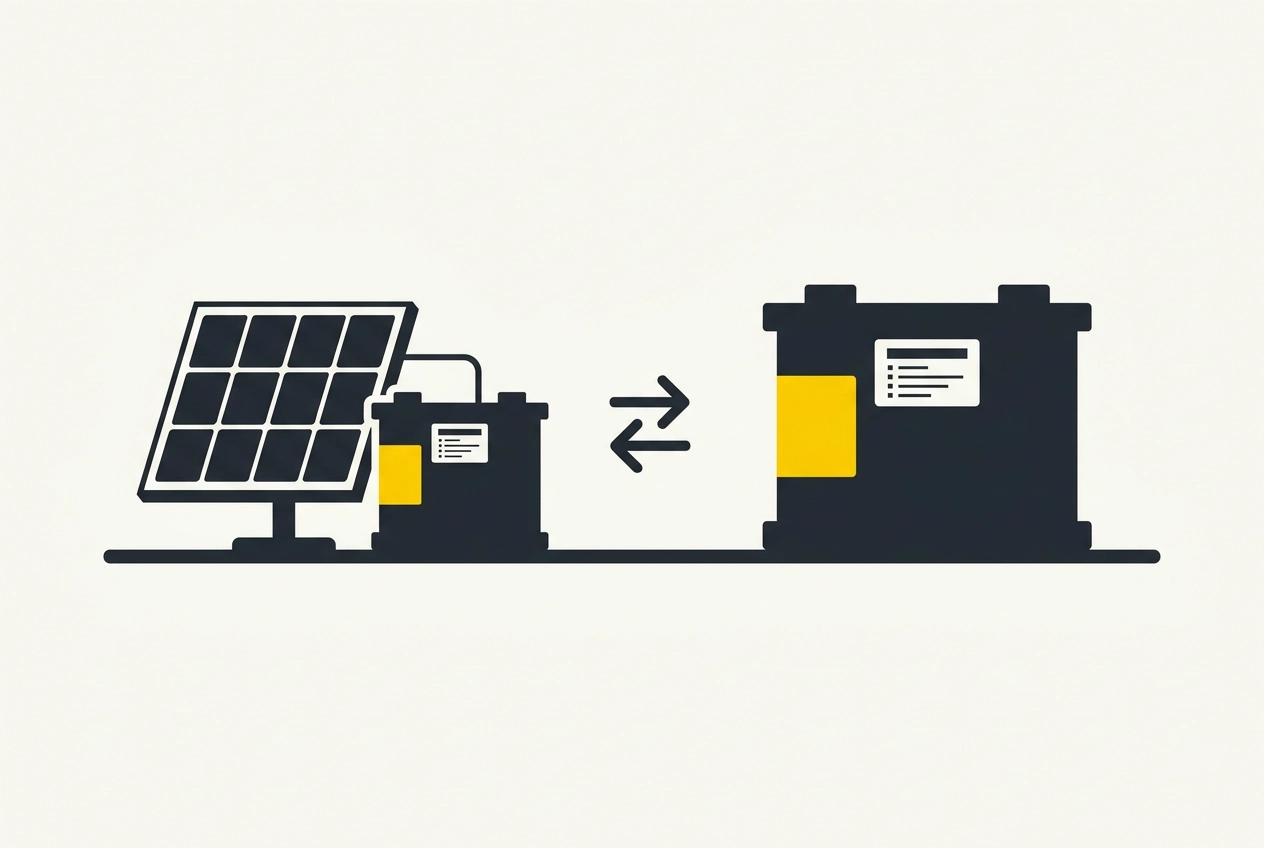
Got a 100-watt panel in your basket and wondering whether it will be enough for a festival? Welcome to the world of camping solar panels, where the sun doesn't shine to spec and the camp next door can happily steal your midday sunshine. I'm not going to give you a panel ranking, but the honest calculation you need first. The question is: solar or a bigger battery? It sounds dry, but it's the decision that saves you from a flat battery on Sunday morning. Because out in a festival field, a panel often delivers less over three days than its wattage might suggest.
We'll look at three lines together: what your camp actually uses, usable sunshine hours in the field rather than just daylight, and charging losses from panel to battery to device. Then there's the underestimated factor of shade from the neighbouring camp. A worked example shows whether a folding solar panel or more capacity is the better fit for the same budget. At the end, there's a simple decision rule: is your camp unshaded during the day? And in the FAQ, we answer the most common questions about camping solar panels. The promise: honest, practical advice without the sales patter.
Why 100 watts on the panel doesn't mean 100 watts in the battery
The wattage on the label isn't a promise for the festival field. It applies in laboratory conditions, with a cool module temperature of 25 degrees and 1000 watts per square metre of sunlight hitting the panel at right angles (Fraunhofer ISE). But your panel beside the gazebo never sits in exactly those conditions. At an air temperature of 32 degrees, the module gets considerably hotter, and heat costs you output: depending on the module, each degree above 25 degrees takes away 0.2 to 0.5 per cent (Fraunhofer ISE).
Out in the field, three things come together that no package leaflet mentions: your actual consumption, your genuinely usable sunshine hours and the losses on the way into the battery. We'll build up those three lines here, and at the end they'll give us the decision between a camping solar panel and more battery capacity.
A warning before you order: at a three-day festival, a camping solar panel often covers only part of your electricity needs. It may take some pressure off your setup, but it won't necessarily do so. And yes, there's an honest answer that hardly any shop will give you: sometimes solar is simply the worse investment for your camp. If you want to think through the storage side first, our guide Which Portable Power Station Really Suits Your Camping Trip? is a good place to start.
So let's do the sums, line by line.
Line 1: What your camp actually uses
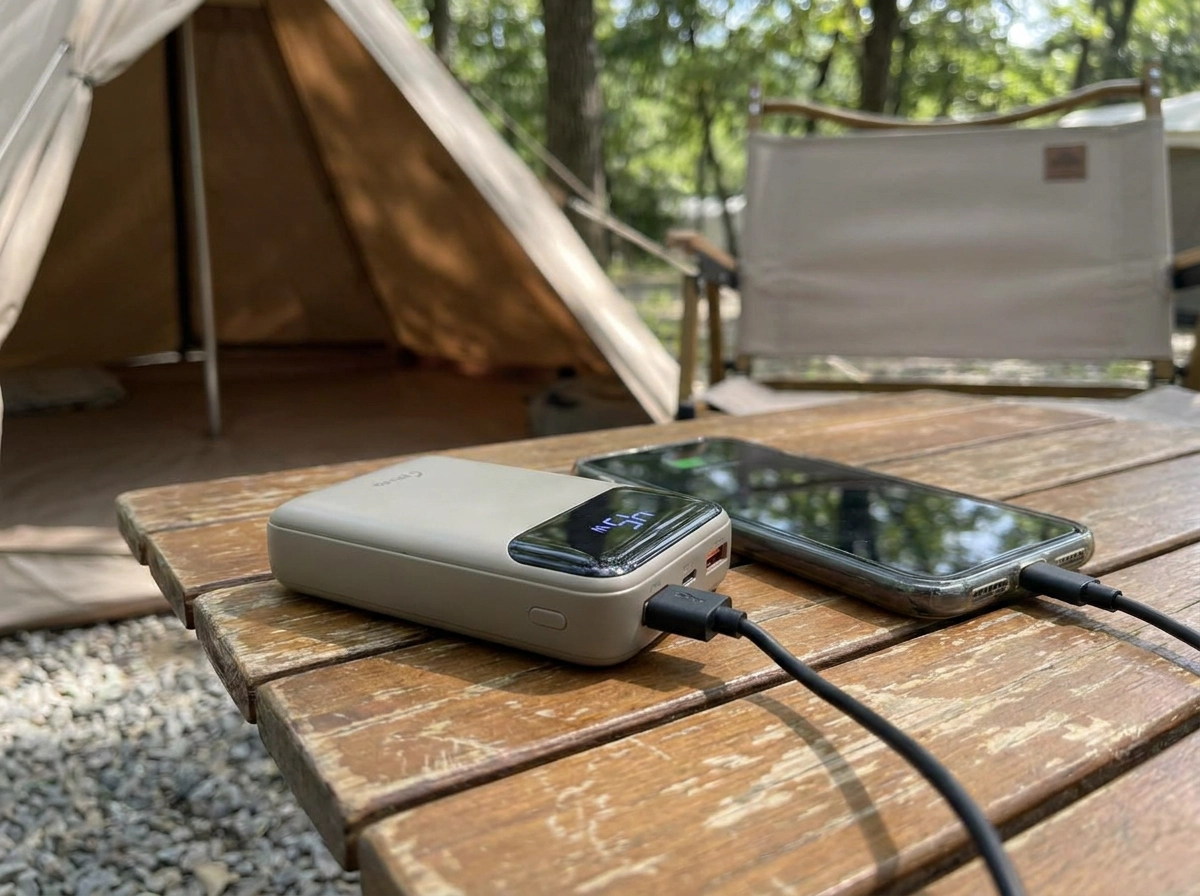
Time for some maths. Watts are simply instantaneous power; Wh measures consumption over time. The formula to remember: Wh = watts × hours.
A few ballpark figures, clearly labelled as assumptions rather than measurements: depending on the model and battery size, one phone charge is roughly in the single-digit to low double-digit Wh range (please check your device's data sheet); a 20,000-mAh power bank theoretically holds around 74 Wh at a cell voltage of 3.7 V (20 Ah × 3.7 V), as a planning assumption, not a manufacturer's guarantee; according to manufacturers' specifications, typical LED camping lights often draw power in the low single-digit watt range, so check your model's data sheet; a cool box draws considerably more. Why the mAh figure alone tells you very little is explained in this technical article.
Four people charging their phones, lights and cameras every day can quickly reach triple-digit Wh consumption per day. The surprise is that the biggest item usually isn't the phone, but the cool box.
Multiply that by three festival days and the size of your group. It's not you draining the battery; it's your crew. Our honest needs assessment shows you how to work out the total for your camp, while the basics article explains why Wh and watts are two different things.
Then write that total down. On paper, on your phone, anywhere. Without this line, the whole calculation is guesswork, and you'll need that figure for the next step: usable sunshine hours.
Line 2: Usable sunshine hours in the field, not just daylight
Got your Wh figure from line 1? Here comes line 2, and it's usually the uncomfortable one.
Daylight doesn't automatically mean usable solar energy: meaningful sunlight is only available within a limited window. In Central Europe, that window is simply limited in summer. Be conservative and budget for a few hours rather than relying on optimism. Deliberately plan around an assumption, for example two to four hours of usable sunlight per day (a guide figure; check the DWD's DUETT data for your location and month), and treat it as an assumption, not a measurement. For reliable figures for your location, it's worth looking at the DWD's DUETT data, which provides monthly solar radiation figures. Please check the level of detail and the figures there yourself rather than guessing.
Orientation and tilt matter too: a panel lying flat on the ground is less well aligned with the sun's position in Central Europe than one set at an angle. Even a shallow tilt towards the south helps more than no tilt at all.
If you're setting up camp for the first time anyway, our Camping for Beginners: The Complete Practical Guide will help with everything around it.
Advertisement · Compare foldable camping solar panels on Amazon* Check the real rated wattage, suitable outputs (USB-C, Anderson/XT60) and whether the panel works with your power station. *Affiliate link to Amazon search results: As an Amazon Associate we earn from qualifying purchases.
We'll work out how much of that actually reaches the battery in line 3.
Line 3: Charging losses from panel to battery to device
Take the sunshine hours from line 2 and knock off another chunk. Between the panel and your phone sits a whole chain: the charge controller, the battery and conversion inside the device. Each stage eats up some of the energy, and none works for free.
For planning purposes, many campers assume that around 60 to 75 per cent of what the panel nominally delivers will be usable (an unsourced guide figure; please check the data sheets for your particular charge controller and battery). This is an assumption, not a measurement. If you want precise figures, turn to manufacturers' specifications or independent test data. Fraunhofer ISE has also noted that module output is often overestimated; you should read the press release itself for the precise scale of the effect.
Temperature plays a part too: an almost full battery accepts very little further charge, while a hot battery reduces its charging current. So a warm afternoon beside the gazebo costs you twice over.
And then there's the cable. A short, thicker cable often helps more than a larger panel because less voltage is lost along the way. Before you upgrade, check the cable first.
When buying, it's therefore worth looking at the charge controller and checking whether the panel feeds directly into the portable power station or runs through an intermediate battery. If you want to sort through your options, our 9 recommendations are a good starting point.
The underestimated factor: shade from the neighbouring camp
Then there's another factor no product page tells you about: your neighbour. Partial shading doesn't mean a linear reduction. With many modules, output drops disproportionately as soon as even part of the surface is shaded. This is a known phenomenon in PV research, although it varies depending on your particular module type. A tent pole, a flagpole or your crew's cool box can be enough. In a festival field, tents, gazebos and flags are packed close together, and the shade from the neighbouring camp takes a leisurely stroll across your panel throughout the day. Add dust, mud splashes and drink stains on the glass surface. It's not disastrous, but it still costs you output.
So here's something worth considering before you buy anything: if your camping solar panel stays unshaded for hours, the calculation looks completely different from one wedged between five gazebos in the campsite jungle. The workaround costs nothing: raise the panel, point it towards a gap that stays clear during the day, and adjust it occasionally. When camping in autumn, with a low sun and banks of fog, this becomes even more important than in midsummer.
A panel that spends three days in constant shade is, above all, an expensive table. That gives you all three lines plus the shading factor. Time for a worked example.
Worked example: a folding solar panel or more capacity for the same budget
After the section on shade, let's get specific. Simply write the three lines one below the other: daily consumption in Wh, usable sunshine hours per day, and the usable proportion after losses. These give you your panel's daily energy yield.
Let's assume your camp needs 300 Wh per day, your folding solar panel has a rated output of 100 W, and you're allowing for three hours of usable sunlight and a usable proportion of 70 per cent. That gives 100 W × 3 h × 0.7 = 210 Wh per day.
That covers around 70 per cent of your needs, not everything. On overcast days, it will be correspondingly less, and that is exactly the shortfall you need to plan for. Otherwise, you'll be standing there on Sunday morning with a flat battery, hunting for a socket after all.
Same budget, different idea: instead of putting the money into a panel, spend it on more battery capacity. A portable power station with a higher Wh rating supplies energy you've charged up at home beforehand. Independent of the weather and easy to plan around.
The honest comparison:
Panel: only works when the sun plays along. On the plus side, it's lightweight and tops up your battery on the go.
More battery capacity: works all the time. But it adds weight and costs money upfront.
Advertisement · See large power banks and power stations on Amazon* If the maths favours a bigger battery: compare capacity in Wh rather than mAh and check the recharge time before your trip. *Affiliate link to Amazon search results: As an Amazon Associate we earn from qualifying purchases.
And as the worked example shows, lower consumption makes both options cheaper. If you base your meals on our 15 Quick No-Cook Festival Food Ideas, you can do without a stove and refrigeration.
And remember: everything here is an assumption, not a measured value. Put in your own figures, or you're just doing the brochure's sums all over again.
The decision rule: is your camp unshaded during the day?
You now know your daily energy yield. But the actual decision comes down to a single question that has nothing to do with watts or Wh: is your camp positioned so that your camping solar panel can face the sun without obstructions for several hours? If the answer is a clear yes, solar is the better investment. If you can't guarantee that clear space, the whole calculation becomes shaky, and more battery capacity is the more honest choice.
For two to three days, a fully charged battery is often less hassle. No daily panel checks, no adjustments, no hoping. Solar comes into its own on longer stays: if you really want to recharge on site without hunting for a socket, a camping solar panel is worth its weight in gold.
Sounds simple, doesn't it? It is. Before buying, look at your pitch, not the data sheet.
FAQ: Camping solar panels — the most common questions
Now for the questions that almost always pop up after that rule.
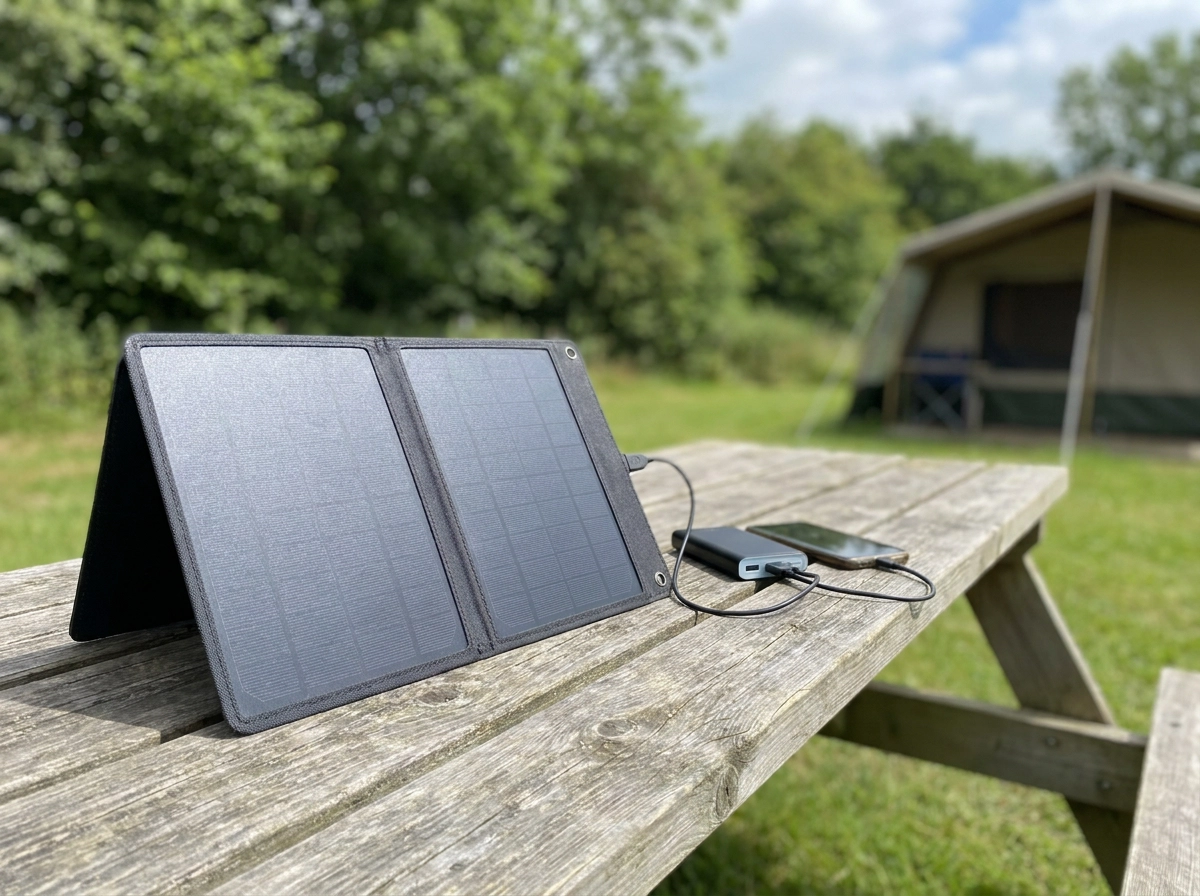
Is a small folding solar panel enough for a phone and power bank? A small folding solar panel with a rated output of 20 to 30 W can charge a phone over the course of a day in good sunshine. Exactly how quickly depends on the charge controller and device. (Check the manufacturer's specifications for your panel.) In shade or cloud, things get slow. For a power bank, that mainly means patience.
How many sunshine hours can I plan for? In Central Europe, usable sunlight hours are limited in summer. Conservatively assume a few hours per day and check the DWD data for your location. A panel lying flat wastes further potential.
Do I need to keep adjusting the panel to follow the sun? A camping solar panel left in a fixed position delivers less. Practical experience suggests that occasionally readjusting the panel gets more out of it. There is no substantiated figure for this, but the effect makes physical sense. And it doesn't cost you an extra penny.
What happens in rain or persistent cloud? Then the panel delivers almost nothing. That's exactly why the battery question isn't a luxury decision, but a matter of reliable planning. Account for this and you won't be left without power on Sunday.
Is solar even worth it for a weekend? If your camp is unshaded and you know your consumption, yes. If not, a bigger battery is often the more relaxed choice. Which Portable Power Station Really Suits Your Camping Trip? explains what capacity fits your setup.
Conclusion: the honest calculation in three lines
That wraps up the FAQ, but the decision is still open. The core remains the three-line calculation: consumption per day, usable sunshine hours, and the usable proportion after charging losses. The three-line calculation from the previous sections gives you the answer, so there's no need to rely on a gut feeling.
Panel or battery: the answer depends on your pitch, not the data sheet.
Want to take your off-grid planning further? Then take a look at our guides to portable power stations, solar panels, power banks and festival lighting. You'll find the building blocks for your camp setup without having to buy everything three times over.
Read next: A 4-Day Festival Charging Plan: Power Up Without the Rows
And if your calculation ultimately says solar won't help you, that's a good buying decision too. More honest than a panel that spends three days in the shade and still hogs space in the boot.
Related camping guides
- Sleeping equipment and protection from wind and rain — match your sleeping setup to night-time temperatures and keep clothing and bedding dry.
- Rain and mud camping packing list — prepare waterproof layers, spare clothing and equipment for wet ground.
- Head torches, camp lighting and off-grid charging — compare lighting options for longer autumn evenings; treat solar charging as a weather-dependent supplement.
- Simple hot meals for chilly camping days — find one-pot recipes and food that keeps without a fridge.